Prof. Kyunghee Byun
A PROMISING APPROACH TO HAIR FOLLICLE REGENERATION IN AGE-RELATED HAIR LOSS
JUVELOOK (Hybrid PDLLA-HA) represents a regenerative strategy for age-related hair loss by modulating macrophage polarisation, enhancing hair follicle stem cell (HFSCS) activity, and restoring the aged scalp microenvironment. Through immune–stem cell crosstalk and mechanotransduction signalling, it offers a biologically driven and mechanistically grounded innovation in hair regeneration.
Hair Regeneration: The Missing Piece of Youthful Appearance
Hair plays a powerful role in how youth, health, and identity are perceived. As hair density naturally declines with age, visible changes can affect not only appearance, but also confidence and overall quality of life. Although modern aesthetic medicine offers numerous options to rejuvenate the face and skin, thinning hair often remains an overlooked contributor to youthful appearance. Growing consumer demand for hair restoration reflects a broader understanding that comprehensive aesthetic care extends beyond the skin, positioning hair regeneration as an essential component of holistic rejuvenation.
How Aging Disrupts Hair Follicle Regeneration
Hair growth is governed by HFSCs, which cycle through three phases: (1) anagen (growth); (2) catagen (regression); and (3) telogen (rest), to sustain follicle renewal. During the resting phase, inhibitory pathways such as bone morphogenetic protein (BMP) signalling maintain stem cell quiescence, preventing premature activation. Transition back to anagen requires activation of the Wnt/β-catenin pathway, a central driver of follicular regeneration. Wnt signalling promotes HFSCs proliferation, lineage commitment, and structural reconstruction of the follicle, thereby initiating new hair growth. With aging, however, this regenerative balance becomes impaired. Stem cell responsiveness declines, Wnt signalling weakens, and inhibitory pathways become dysregulated. The result is disrupted hair cycling, follicular miniturisation, and progressive thinning. These biological changes underscore why preserving stem cell activity has become a central focus of modern hair restoration strategies.
Advancing Hair Regeneration: Evidence from Hybrid PDLLA–HA Research
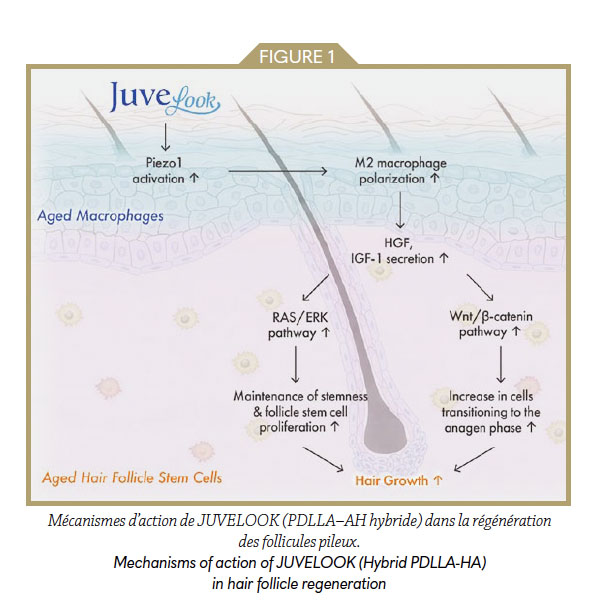
Recent in vitro and in vivo investigations reveal that hybrid PDLLA–HA promotes hair follicle regeneration through a coordinated immune–stem cell signalling cascade centred on the mechanosensitive ion channel Piezo (1).
PDLLA–HA treatment significantly upregulated Piezo1 expression, triggering macrophage polarisation toward the regenerative, anti-inflammatory M2 phenotype. This transition enhanced secretion of key trophic factors, hepatocyte growth factor (HGF) and insulin-like growth factor-1 (IGF-1), which act as paracrine signals supporting tissue repair and stem cell activation. These growth factors subsequently stimulated the RAS/ERK signalling pathway, increasing HFSCs proliferation through c-Fos activation while preserving stem cell identity. In parallel, robust activation of the Wnt/β-catenin pathway was observed, marked by upregulation of canonical targets including Axin2, LEF1, and Lgr5. Together these pathways synergistically reinforced HFSCs renewal and sustained entry into the anagen phase of the hair cycle (Figure 1).
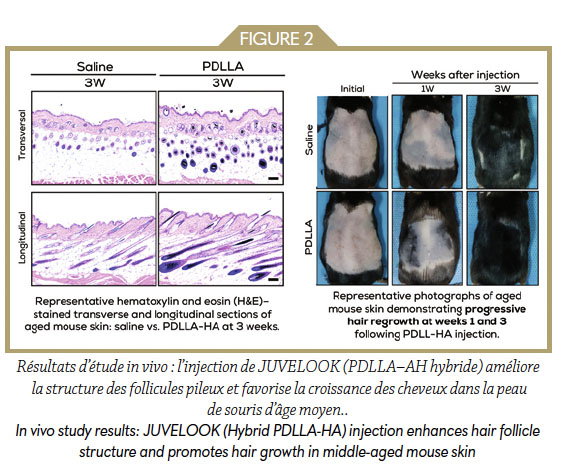
Histological analyses were consistent with these molecular findings. Treated tissues demonstrated increased follicle number, greater follicular diameter, improved structural maturity, and a higher proportion of follicles in the active growth phase (Figure 2). Collectively, these results indicate that PDLLA–HA restores regenerative signalling in aging skin by integrating Piezo1-mediated M2 macrophage modulation with hair follicle stem cell activation, a biologically driven mechanism supporting hair follicle renewal.
Real-World Clinical Outcomes
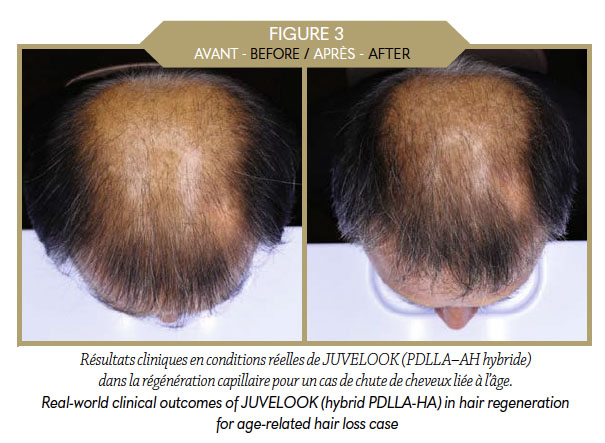
Clinical experience in Korea suggests that JUVELOOK (Hybrid PDLLA–HA) is both effective and well tolerated in patients with age-related hair loss. Observed improvements in hair density and thickness support the translational relevance of the preclinical findings. These real-world outcomes reinforce the role of hybrid PDLLA–HA as a biologically driven biostimulator capable of restoring scalp regenerative capacity and improving hair growth parameters (Figure 3).
JUVELOOK (Hybrid PDLLA–HA) activates Piezo1-mediated mechanotransduction to promote regenerative M2 macrophage polarisation and restore hair follicle stem cell activity via the RAS/ERK and Wnt/β-catenin pathways. By rejuvenating the aged scalp microenvironment and re-establishing regenerative signalling networks, it promotes sustained hair growth and represents a promising frontier in regenerative hair therapy.
Prof. Kyunghee Byun

Prof. Kyunghee Byun, MD, PhD is a Professor at the College of Medicine, Gachon University. She serves as Head Professor of the Department of Anatomy and holds executive roles in the Korean Society of Anatomy, Korean Proteomics Society, and Korea Pulmonary Hypertension Research Association.