Dr Georges Ziade
Polynucleotide biostimulation transforms undereye rejuvenation, delivering a safe regenerative approach with natural, long-lasting results.
Polynucleotides offer an innovative approach to smoothing periorbital wrinkles. Their regenerative activity enhances skin texture, elasticity, and radiance while supporting dermal repair mechanisms and promoting balanced tissue function overall, ensuring excellent tolerability in this delicate area.
A new regenerative approach to the eye contour
Polynucleotides (PN) represent a major advance in the treatment of lower-eyelid wrinkles. They provide a non-volumising regenerative approach that is particularly suited to the peri-orbital area, where skin thinness requires safe, physiological and progressive solutions.
Polynucleotides: biological mechanisms and peri-orbital relevance
Derived from highly purified salmon DNA, PN show strong molecular similarity to human DNA, ensuring excellent biocompatibility. Their high-molecular-weight biopolymer structure gives them specific visco-elastic properties, allowing homogeneous dermal diffusion and limiting the risk of irregularities in this delicate area. Biologically, polynucleotides interact with adenosine A2A receptors, activating pathways involved in tissue repair, fibroblast stimulation, collagen synthesis and improved dermal elasticity. This biostimulatory action promotes gradual extracellular matrix remodelling without volumising effects.
PN and PDRN: structural distinctions relevant to clinical practice
PN differ from polydeoxyribonucleotides (PDRN) through their higher molecular weight and a three-dimensional structure closer to native human DNA. This architecture provides superior visco-elasticity, more stable dermal support and a prolonged duration of action, while maintaining an excellent tolerability profile
Clinical outcomes: progressive improvement and patient satisfaction
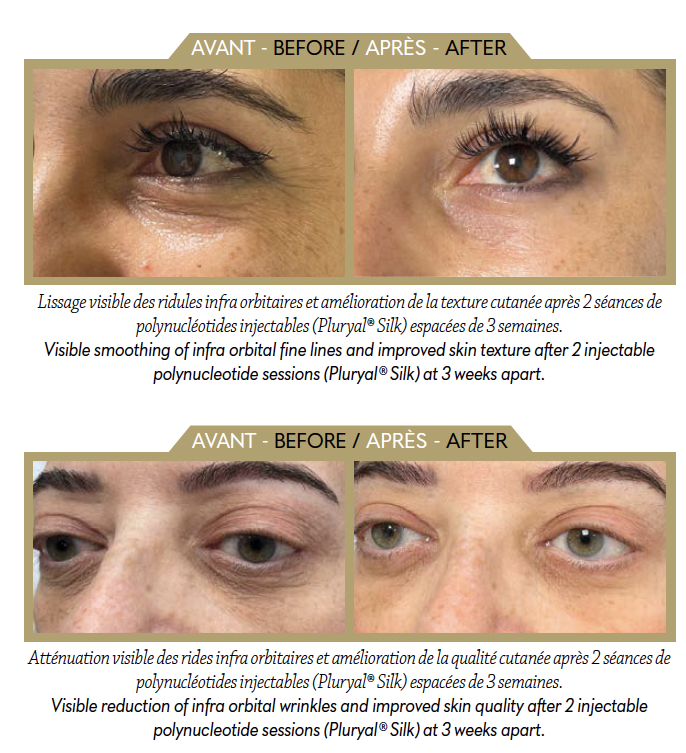
In a prospective study(1) involving 42 patients, injection of 2 mL of PN at 7.5 mg/mL, using Pluryal® Silk (MD Skin Solutions, Luxembourg), resulted in progressive improvement of lower-eyelid wrinkles and crow’s feet. FACE-Q™ scores demonstrated visible benefits from the first session, with peak efficacy at 3 months after 2 treatments. Standardised photographs confirmed smoother skin texture and a visibly refreshed eye contour.
Tolerance, safety and role within the injectable ARSENAL
The technique is based on intradermal micro-injections delivered in a nappage pattern, creating a mild “tenting(2)” effect that facilitates product diffusion. Post-treatment reactions are minimal, limited to mild oedema or rare transient bruising. Data shows a mean improvement of more than 9 points in FACE-Q™ scores at 3 months, with clinically relevant results persisting up to 6 months.
Personalised protocols and long-lasting improvement
Protocols are adapted to baseline severity:
- 2 sessions spaced 3 weeks apart for mild to moderate wrinkles
- 3 initial sessions for more pronounced aging, followed by personalised maintenance.
Through their biostimulatory effect, PN progressively enhance skin luminosity, density and homogeneity, while preserving the natural harmony of the eyes.
POLYNUCLEOTIDES PROVIDE A REGENERATIVE APPROACH FOR UNDEREYE REJUVENATION
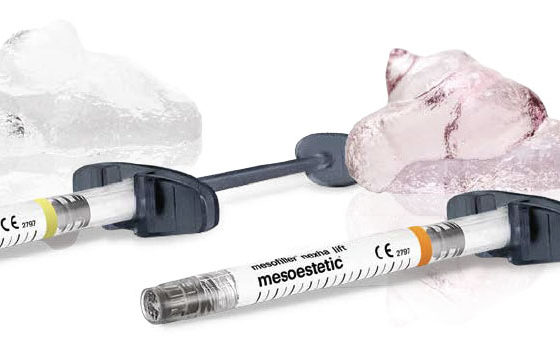
Delivered as highly purified injectable PN at 7.5 mg/mL, such as Pluryal® Silk (MD Skin Solutions, Luxembourg), they support collagen synthesis and fibroblast activity, leading to lasting improvements in texture, elasticity, and radiance.
1-Efficacy of Polynucleotide Injections for the Treatment of Undereye Wrinkles: A Prospective study. Ziade G, Keyrouz E, Karam D, Sweidan D, Daou D, Fidawi G – pending publication
2-Subtle, temporary skin lifting after intradermal micro-injection, reflecting accurate placement and promoting even diffusion without volumizing effects.
Dr Georges Ziade

Consultant Facial Plastic Surgeon and General Manager at Beauty Experts (Canada) and Dr Georges Ziade Clinics (Lebanon & Dubai). Fellow of the American College of Surgeons, AAFPRS member, Clinical Assistant Professor at LAU, international trainer and author of 30+ medical publications.
More: georgesziade.com