Pr Kyunghee Byun
REVERSING AGING BEYOND COLLAGEN SYNTHESIS
VAIM’s hybrid formulation of poly-D-L-lactic acid (PDLLA) and hyaluronic acid (HA) sets a new benchmark in regenerative aesthetics, emerging as the first biostimulator with five clearly defined mechanisms of action that restore vascularity, reinforce structure, refine pigmentation, and revive volume.
A New Era in Regenerative Aesthetics
Modern patients no longer pursue instant correction but true biological rejuvenation. Many biostimulators promise regeneration, yet few clearly demonstrate how it occurs. Through our mechanism-focused research on JUVELOOK (20–40 μm, dermal) and LENISNA (40–60 μm, subcutaneous), we confirmed their ability to restore aging skin through defined scientific pathways.
Regeneration Beyond Collagen
JUVELOOK does more than stimulate collagen. It reactivates angiogenesis, modulates aging immune pathways, protects the basement membrane, and restores subcutaneous white adipose tissue (sWAT) through adipogenesis, creating synchronised multi-layer renewal.
1. Angiogenesis: Restoring Microcirculation
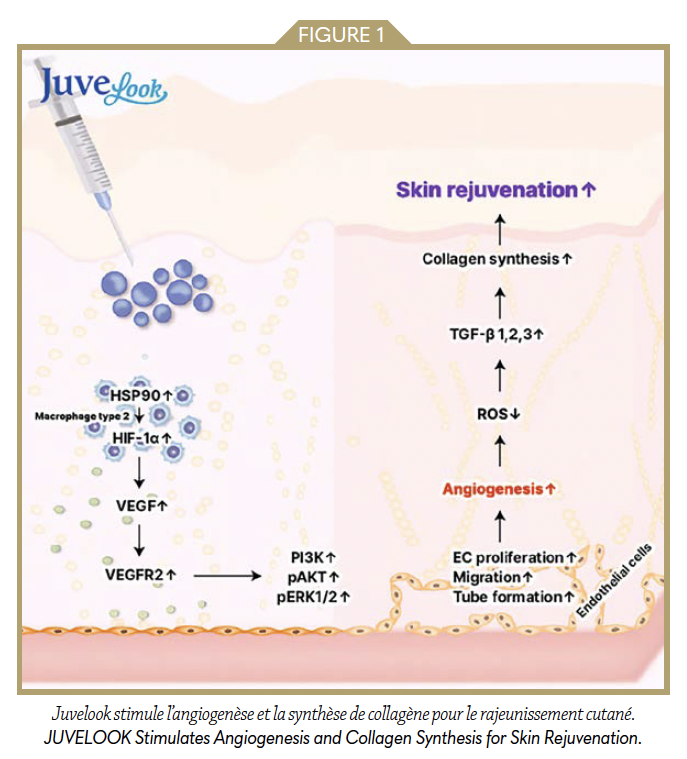
Aging reduces angiogenic mediators such as HSP90, HIF-1α, and VEGF, lowering perfusion and increasing oxidative damage. JUVELOOK reverses this decline by stimulating VEGF–VEGFR2 signalling, activating PI3K–AKT–ERK pathways and endothelial proliferation. Newly formed capillaries improve oxygen delivery, reduce ROS, and elevate TGF-β, supporting collagen renewal and structural recovery at the dermal level (figure 1).
2. Macrophages & Adipose-derived Stem Cells (ASCs) Modulation: Rebuilding the Extracellular Matrix
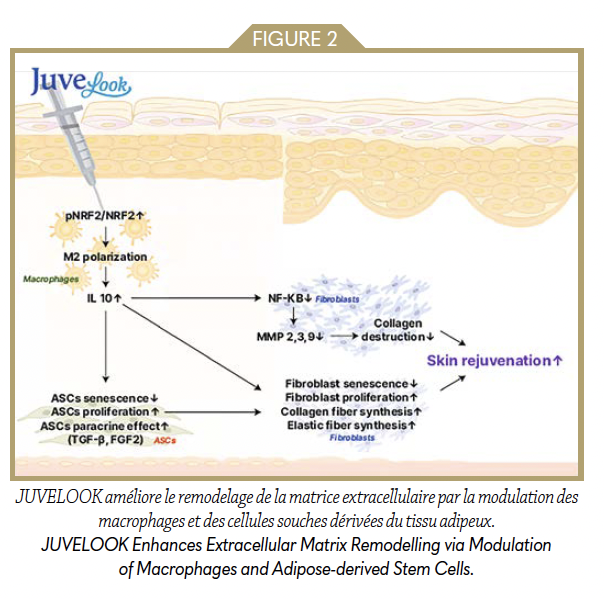
While HA fillers provide temporary correction, they do not reverse cellular senescence. JUVELOOK upregulates NRF2, decreases NF-κB and MMP activity, and shifts macrophages from macrophage type 1 (M1) to macrophage type 2 (M2) phenotype. M2 macrophages increase IL-10, TGF-β, and FGF2 secretion, revitalising ASCs. Activated ASCs restore fibroblast function by stimulating sustained collagen and elastin synthesis, rebuilding long-term dermal architecture (figure 2).
3. Basement Membrane Protection: Addressing Dermal Pigmentation
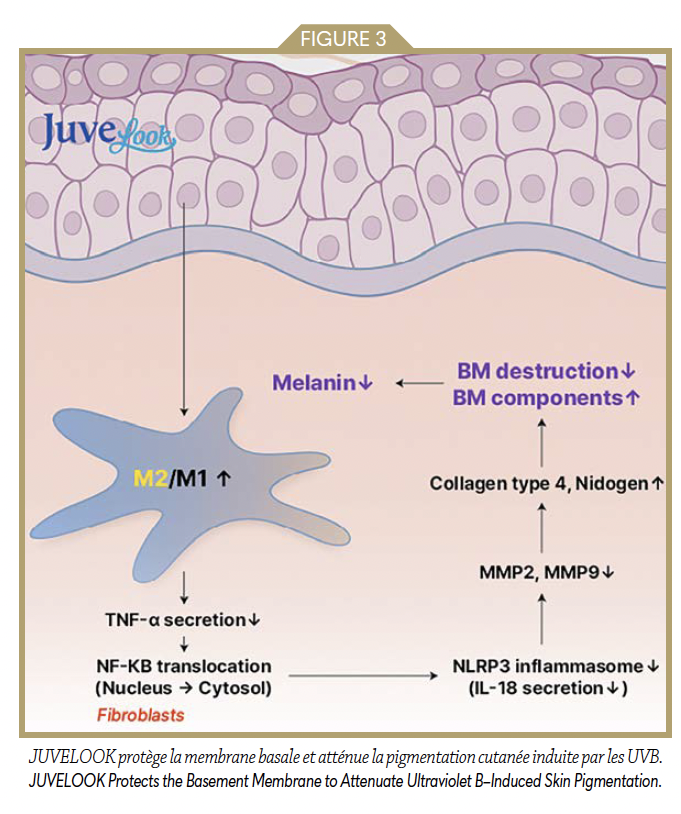
Photoaging disrupts the basement membrane (BM), allowing melanin to deposit into the dermis. Through reduced M1 activity, TNF-α, and NF-κB signaling, JUVELOOK increases key BM components, collagen IV and nidogen, preserving structural boundaries and preventing pigment migration. This explains its clinical brightening effects beyond surface-level melanin control (figure 3).
4. Adipogenesis: Restoring Subcutaneous Volume
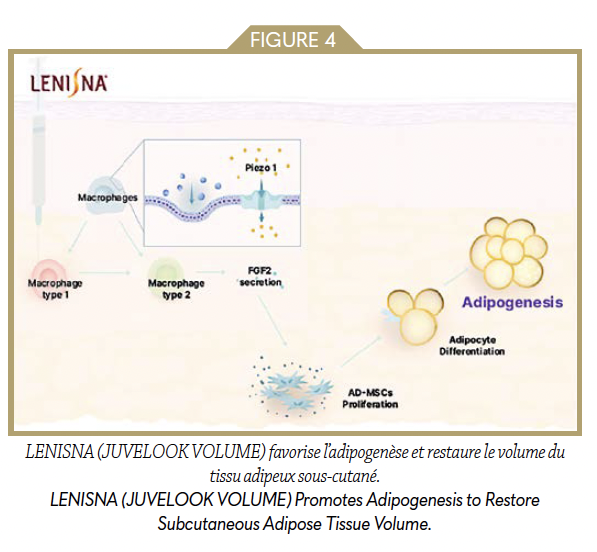
With age, sWAT thins and facial contours collapse. LENISNA activates Piezo1 channels and M2 polarisation, increasing FGF2 and downstream PPAR-γ and ERK1/2 activity. This promotes healthy adipocyte formation without hypertrophy, gradually rebuilding sWAT thickness. The result is natural volumisation that complements dermal regeneration (figure 4).
5. Collagen & Elastin Remodelling: Lasting Structural Renewal
By harmonising immune balance, stem cell function, and vascular support, JUVELOOK maintains active collagen–elastin remodelling for months post-treatment.
Clinical Evidence & Safety: Where Actions Translate to Results
These mechanisms translate into verified improvement in atrophic scars, stretch marks, melasma, rosacea, tear trough, enlarged pores, temporal hollowing, and laxity—delivering dual dermal rejuvenation and volume restoration. Safety is strengthened by JUVELOOK’s low glass-transition temperature, allowing RF-assisted softening and predictable management in rare nodular cases. With five validated regenerative actions, JUVELOOK continues to expand its clinical indications, offering physicians wider treatment versatility and patient-targeted, natural outcomes. With five proven mechanisms and clear biological pathways, JUVELOOK and LENISNA offer predictable, safe, and regenerative outcomes, giving clinicians true confidence in both efficacy and long-term tissue health.
Pr Kyunghee Byun
Prof. Kyunghee Byun, MD, PhD is a Professor at the College of Medicine, Gachon University. She serves as Head Professor of the Department of Anatomy and holds executive roles in the Korean Society of Anatomy, Korean Proteomics Society, and Korea Pulmonary Hypertension Research Association.