Dr Patrick Trevidic
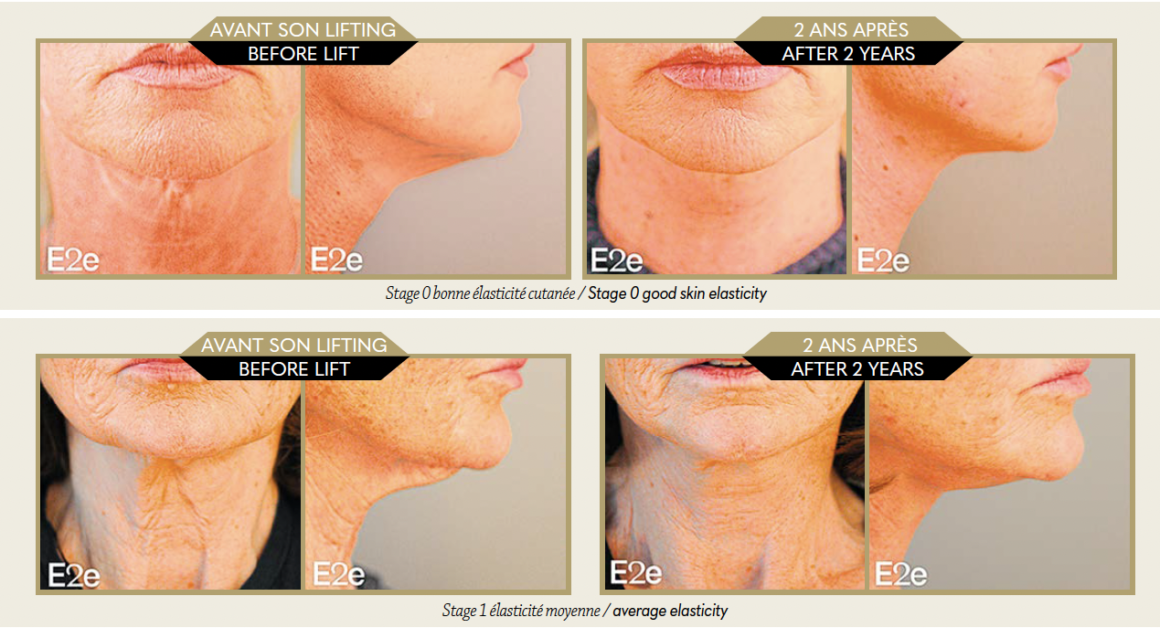
After 10 years of research and three scientific articles published, Professor Patrick Trévidic tells us about his new lifting technique that optimises this procedure by controlling the spasticity of the neck muscles. If this is not treated, there is a 30% chance of relapse after a year.
Interview by Thiery Piolatto
Lifts are expensive!
It is important to remember that optimising the effects of a lift over time is particularly useful, as these operations can cost between 8 and 15,000 euros. Dr Trévidic is an ardent defender of this procedure because he believes that, even though there are less invasive techniques such as resorbable tensor threads (which need replacing every 12 to 24 months), radiofrequency or ultrasound sessions (which also need repeating regularly), investing in a lift is still economical. He also highlights the fact that the after-effects of the surgery have lessened over the years, going from 2 to 4 weeks’ convalescence ten years ago to 7 to 10 days currently. Finally, taut-looking faces are a thing of the past, with the arrival of techniques such as the “Deep Plane”, which involves repositioning the deep tissues rather than pulling the skin. We asked Professor Trévidic to tell us about the technique he has developed to maintain the effects of a lift over the long term: the Allure Lift.
Anti-Age-Magazine: What are the advantages of this technique?
PR. Patrick trévidic: We can reduce the relapse rate from 30% to 5%. We’ve changed the paradigm. In the beginning, our Expert 2 Expert group called it the “Denervation Neck Lift”, but in the end we went for “Allure Lift”. We thought a lot about the failings of neck lifts: we tend to think that our muscles lose strength as we age, but we realised that is not the case in the face, as the muscles’ strength actually increases. This is also somewhat true for the expression lines, but more significant for the neck muscles. Another example is the eyebrows: on 150 patients studied, a third had stable eyebrows, a third had too-high eyebrows and a third had sagging eyebrows. For me, a surgical lift offers spectacular results. But we cannot ignore the fact that the platysmal bands, which become more prominent as we age, pose a real challenge, even for top specialists.
AAM: What is the technique?
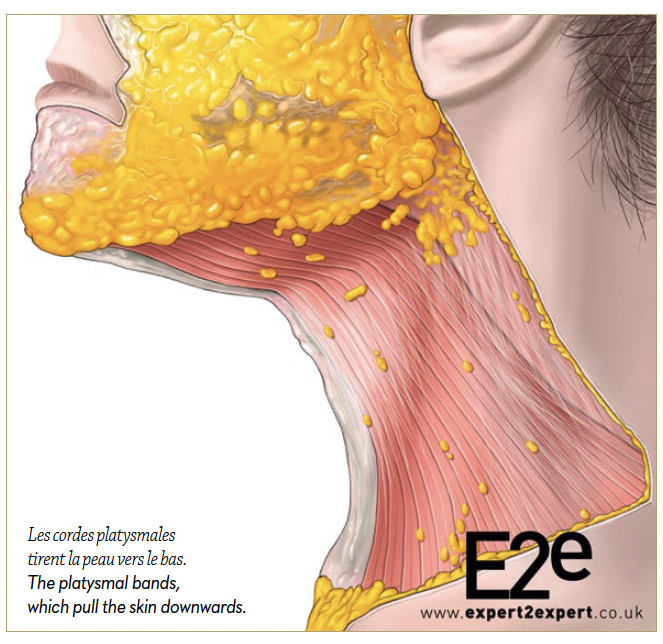
PR. P.T.: Neck aging is characterised by the appearance of vertical muscle bands, which we call platysmal bands, and horizontal neck wrinkles. Contrary to popular belief, these signs of aging are not caused by sagging tissues, but rather by the action of the superficial neck muscle, the platysma. With aging, this muscle tends to stretch, meaning that it pulls the skin and fat downwards, leading to the appearance of horizontal lines. This was shown in a study carried out in 2017 on patients with permanent, unilateral, non-spasmodic facial paralysis. These patients presented a platysmal band on the non-paralysed side, but it was absent on their paralysed side, which proved that these structures were not the result of skin or muscle sagging, but rather due to a hyperactive platysma muscle. What is more, these patients displayed very little skin ptosis on the paralysed side compared with the non-paralysed side, suggesting that the skin on the neck follows the position and action of the platysma muscle, not the other way around. It is thanks to this study that a new surgical paradigm was introduced, going from the traditional tightening of the neck structures to targeting the probable cause – excessive muscle activity – by denervating the platysma. In the Allure Lift technique, we locate then section the branches of nerves going into the platysma. In terms of results, it is similar to using botulinum toxin. Before, when the problem reappeared after a year or 18 months, the patient would say, “It’s not as tight as it was.” We would then give them toxin injections to compensate, in a procedure called the “Nefertiti Lift”. But, if these injections do not work very well, our surgical technique will undoubtedly do a better job.
What are the advantages? When you have had an operation that takes 2 to 3 hours and you are delighted with the results, but you start to see your neck sag again after just one year – when it should last ten years – because the muscle has not been denervated, it would be a shame not to try and improve upon it. This technique only takes a surgeon 30 minutes longer, so it is a good investment, especially given the results.
AAM: Is this surgery being developed further?
PR. P.T.: Yes, we are trying to develop the techniques further to enable as many people as possible to benefit from it. Our group of experts is very open and, at the latest conference hosted by the French Society of Plastic Surgeons, I spoke in depth about the Allure Lift.
AAM: Are there any adverse effects?
PR. P.T.: We have not recorded any adverse effects in the last four years. When we published the last scientific article, I had already operated on 80 patients, who had all been monitored as part of a study. We already have 4-5 years’ hindsight.
Dr Patrick Trevidic
Plastic, reconstructive and aesthetic surgeon. Member of many international reconstructive and aesthetic societies. He is the Chairman of the reconstructive and plastic surgery department at Sainte-Anne Hospital in Paris. He has published more than 60 peer-reviewed scientific articles. He has directed the development and publication of 11 comprehensive reference books on medicine and aesthetic surgery. Doctor Trevidic leads and participates in many studies on aesthetic medicine and surgery.
More: trevidic.com