Dr Jean-Marc Adda
From the Evolution of Hyaluronic Acid Gels to the Management of Vascular Risk (Necrosis) in a Context of Growing Demand
The injection of hyaluronic acid gels has become one of the leading procedures in aesthetic medicine. This widespread adoption is supported by continuous technological progress in gels (density, cohesivity, rheology, cross-linking), global growth in demand and procedure volume, and an increase in the number of injectors. At the same time, the landscape has become more complex: the development of non-medical operators in certain countries, the emergence of “fake injectors”, misuse of devices such as hyaluron pens, and the circulation of counterfeit products. Serious complications remain rare, but vascular accidents (arterial occlusion) can lead to cutaneous ischaemia and necrosis, and even ocular or neurological complications. This article provides a 2026 update focused on: product evolution, the evolution of practices (needles versus cannulas), the anatomy of high-risk areas, and key references concerning necrosis and vascular occlusions.
2026 Context: A Mature Practice Facing New Challenges

Aesthetic procedures continue to grow worldwide. International surveys and professional reports show very high volumes of aesthetic procedures and sustained growth dynamics.
This increase in activity is mechanically accompanied by:
• An increase in the number of injectors (across all specialisations, depending on the country),
• Younger and more frequent demand (touch-ups, micro-corrections),
• And, in certain territories, a blurring of the “medical / non-medical” boundary (aesthetic medicine versus beauty industry), with procedures performed by non-physicians and significant regulatory variability.
Evolution of Hyaluronic Acid Gels: Progress and Limitations
The history of hyaluronic acid fillers, as well as tissue stimulators, has been marked by the continuous improvement of their physicochemical properties. Cross-linking, cohesivity and rheological parameters have made it possible to adapt gels to different anatomical layers and aesthetic objectives. Today, safety therefore depends on the precise matching between the product, the area treated and the injection plane.
Vascular Risk: A Rare but Irreducible Event
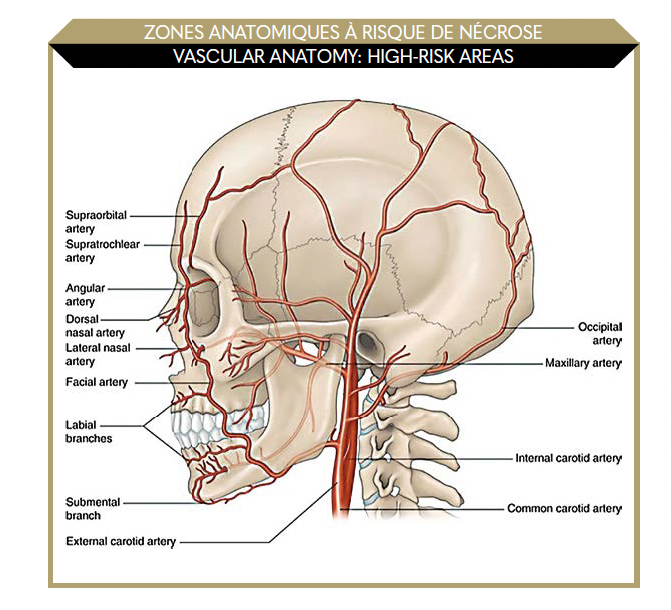
Vascular complications mainly result from intravascular embolisation or extravascular compression. They can lead to cutaneous ischaemia, necrosis and ophthalmic complications. Areas of the face rich in arterial anastomoses remain particularly at risk.
Anatomical Considerations: High-Risk Areas and Vascular Logic (Territory-Based Approach)
The face combines:
• A superficial and deep arterial network,
• Anastomoses between the external and internal carotid systems (particularly through the orbit),
• Interindividual anatomical variations,
• And areas where vessels of significant calibre may be located close to injection planes.
Modern recommendations emphasise a “territory/angiosome” approach, which is useful for anticipating the pattern of ischaemia and guiding management.
Areas Traditionally Considered High Risk (Ischaemia/Necrosis)
Without being exhaustive, the areas most frequently described as being at greater risk of occlusion and cutaneous ischaemia include:
• Glabella and forehead: supratrochlear and supraorbital arteries (risk of local ischaemia and, through anastomoses, ophthalmic risk).
• Nose (dorsum, tip, alae): dorsal nasal artery, branches of the angular artery, post-surgical variations; nasal skin poorly tolerates ischaemia.
• Nasolabial fold / angular region: proximity to the facial and angular arteries; a “classic” area for reported necrosis.
• Tear trough / infraorbital region: infraorbital vessels, orbital proximity.
• Temple: superficial temporal artery and branches; multiple planes and variations; caution with bolus injections.
• Lips: labial arteries; occlusion is possible, most often reversible but potentially necrotic depending on severity and treatment delay.
The literature on vascular compromise and occlusion management guidelines describes in detail the warning signs and the importance of immediate diagnosis to prevent necrosis.
Factors Increasing Anatomical and Clinical Risk
• History of surgery (e.g. rhinoplasty) modifying vascular pathways and tissue planes.
• Thin skin, scarred skin or an unfavourable vascular condition.
• Deep “blind” injections in areas with anatomical variations.
• Large boluses and high injection pressure.
Occlusion management recommendations also emphasise caution in previously operated areas.
Facial Vascular Anatomy: High-Risk Areas
Techniques and Prevention: Between Progress and a False Sense of Security
The introduction of microcannulas has reduced the frequency of occlusions without eliminating them. Aspiration testing, long recommended, is now recognised as unreliable. High-frequency ultrasound opens promising perspectives for vascular visualisation and complication management, but its implementation remains limited by training requirements, cost and procedural time. Recent observational data show a high level of concern among practitioners regarding intravascular risk and a growing need for solutions providing objective real-time feedback.
Conclusion and Perspectives: Towards the Need for a New Paradigm of Instrumental Safety
In 2026, the safety of hyaluronic acid injections can no longer rely exclusively on operator expertise, anatomical knowledge and adherence to good technical practices. Despite continuous improvements in injectable products, the widespread use of cannulas and the emergence of tools such as ultrasound, the risk of intravascular injection and cutaneous necrosis remains irreducible.
Thus, at a time when aesthetic medicine is entering a phase of scientific maturity, the safety of hyaluronic acid injections must evolve from an exclusively behavioural approach towards an integrated approach combining medical expertise and technological innovation.
Dr Jean-Marc Adda

Clinical Director of Aesthetic Medicine and Laser Treatments in Boulogne-Billancourt. University Diploma in Facial Injections for Aesthetic Purposes, University Diploma in Evaluation and Control of Injection and Volumetric Techniques in Dermatology and Plastic Surgery, Diploma of the National College of Aesthetic Medicine, Inter-University Diploma in Medical Lasers, State Doctorate in Medicine.
Infos: dr-adda.fr