Dr Lyes Kéchid
ExoTMS stimulation opens up a new avenue in aesthetics: modulating brain networks to strengthen adherence, emotional balance, and treatment effectiveness.
Aesthetic medicine is evolving towards a holistic approach where cognitive factors directly influence consistency, motivation, and perception of results. ExoTMS, the result of advances in neuromodulation, offers a way to act on these essential determinants.
Aesthetic medicine is entering a phase of maturity: the performance of a procedure no longer depends solely on skin or tissue parameters, but also on cognitive and emotional determinants that condition adherence, regularity, and perception of results. In this context, ExoTMS-optimised transcranial magnetic stimulation (TMS) provides a complementary neurofunctional approach.
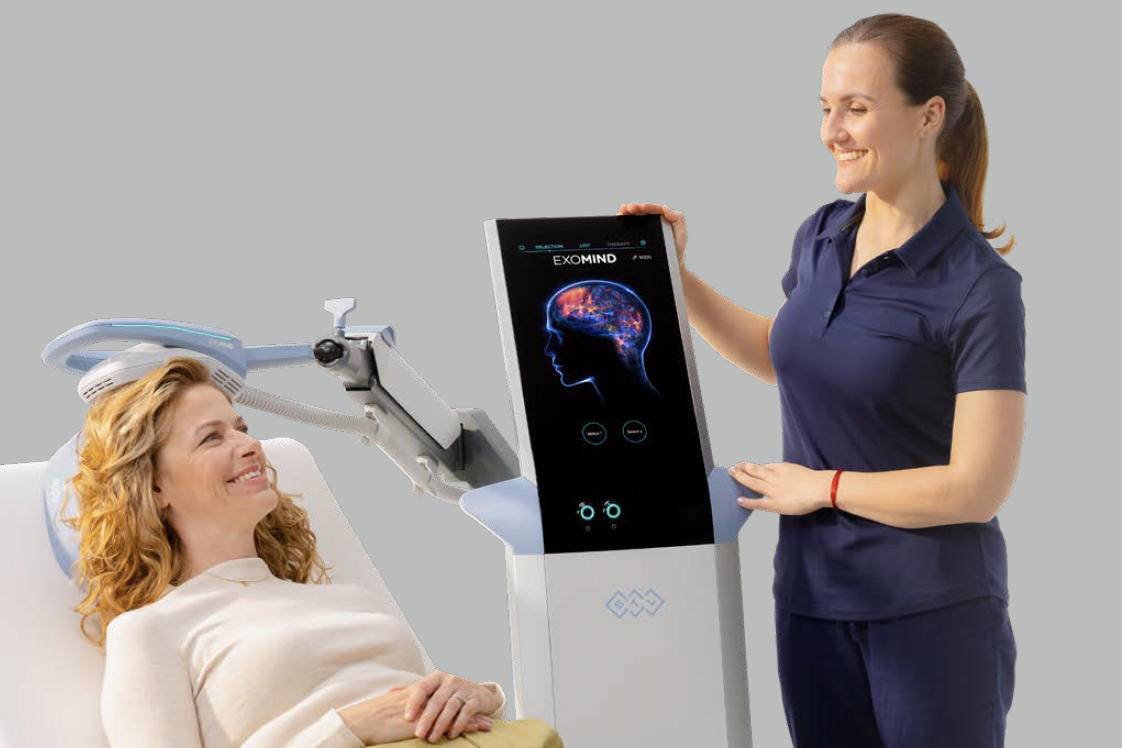
Target: the dorsolateral prefrontal cortex (DLPFC), involved in emotional regulation, planning, decision-making, and impulse inhibition. Hypoactivity of the DLPFC is frequently described in contemporary lifestyles. ExoTMS acts on this area (effective penetration ~3 cm). Hypothesis: restoring prefrontal activity can strengthen emotional stability, control of eating behaviours, motivation, and consistency of routines, which are key factors in maximise medicine. ExoTMS prioritising standard rTMS to maximize effectiveness while prioritizing comfort: more homogeneous field (patented coils), air cooling allowing for more pulses, “ramp” pulses limiting jolts, and anti-adaptive parameters (dynamic frequency modulation) reducing habituation.
The result: non-invasive stimulation that is better tolerated, aiming for more robust and potentially lasting modulation of fronto-limbic networks, without pain or significant discomfort. Neurobiologically, adult neuroplasticity (including functional MRI) shows that repeated stimulation strengthens circuits. Stimulation of the DLPFC is associated with increased release of neurotransmitters (dopamine, serotonin, acetylcholine), synaptic strengthening, and improved prefrontal-limbic communication. Expected effects: decreased amygdala hyperactivity, striatal modulation (compulsive eating), improved executive functions (inhibitory control, attention, planning).
Clinical data (field/literature)
- Exomind (internal): reduction in food cravings and average weight loss at 1 month.
- Cavicchioli et al., 2022 (N=402): significant improvement in BMI. • Kim et al., 2019: –2.75 kg vs. –0.38 kg in 4 weeks.
- Zeng, 2021: reduction in caloric intake after high-frequency DLPFC rTMS.
- Stress/sleep (internal): 85% subjective reduction in stress; 77.7% improvement in falling asleep.
- Sun, 2020 (meta-analysis, 36 trials): improvement in PSQI and increase in deep sleep.
- Executive functions: improved concentration, emotional stability, and motivation, consistent with the role of the DLPFC.
Limitation: internal data = feedback/preliminary studies; multicentre controlled trials are still needed. In practice: 4 to 6 sessions of 24.5 min, intensity calibrated to the motor threshold; non-invasive, hands-free device, no social exclusion. Before/after cosmetic procedures, ExoTMS can support sleep/recovery, emotional regulation, and adherence to weight loss protocols, offering a complementary strategy to support skin, tissue, and metabolic results.
Dr Lyes Kéchid

Psychiatrist and aesthetic physician, clinician, trained at Amiens University Hospital and the University of Paris. Pioneer of Deep TMS (since 2016), national expert. Expert in neurotechnologies (VR, neuromodulation, sleep, Exomind) for well-being and brain longevity.