Dr Isabelle Meurgey
Long confined to a gentle aesthetic approach, facial acupuncture is now establishing itself as a genuine anti-aging medicine tool.
Far more than a superficial treatment, it acts at the interface between the skin, the nervous system and the biological mechanisms of aging. In a context where skin aging is now understood as the local expression of systemic phenomena—chronic low-grade inflammation, oxidative stress and mitochondrial dysfunction—facial acupuncture has a particularly relevant role.
The face, a mirror of biological status

The face is an anatomical area of exceptional richness: dense innervation, fine microvascularisation, a superficial lymphatic network and a deep connection with the central nervous system. This configuration explains why any facial stimulation can induce both local and central responses. In Traditional Chinese Medicine, the face is described as a reflection of the energetic state of the internal organs: the forehead is associated with the digestive sphere, the eyebrows with the liver and stress management, the eye contour with the kidneys and deep aging, the cheekbones with the lungs and immunity, and the jawline with the hormonal and emotional sphere. Today, this interpretation converges with modern concepts of neurovascular-immune reflexes, in which the skin becomes a true organ of communication with the entire body.
A measurable biological action on the skin
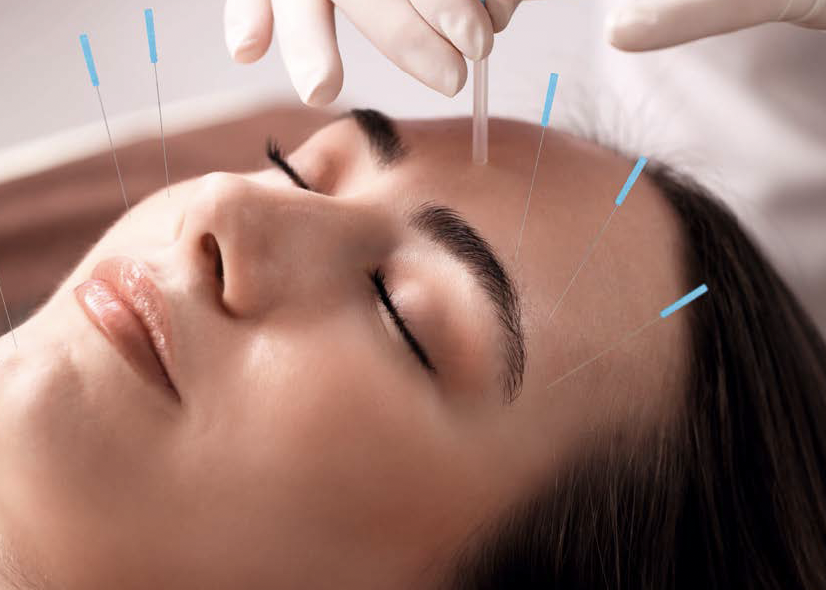
The placement of fine needles on facial points induces a cascade of physiological responses:
• stimulation of microcirculation,
• improvement of lymphatic drainage,
• increased tissue oxygenation,
• activation of fibroblasts, stimulating collagen and elastin synthesis.
This controlled micro-stress acts as a hormetic signal, promoting skin repair and regeneration. Clinically, a progressive improvement in dermal density, elasticity, skin radiance and normalisation of facial muscle tone is observed, without freezing facial expressions.
Inflammaging: an often underestimated lever
Skin ageing is now recognised as a visible manifestation of chronic low-grade inflammation, or inflammaging. Chronic stress, metabolic imbalances, dysbiosis and oxidative overload contribute to this silent inflammation, which progressively alters skin quality. Several studies show that acupuncture is capable of modulating the inflammatory response by reducing the expression of pro-inflammatory cytokines such as IL-6 and TNF-α. By acting on the autonomic nervous system, facial acupuncture contributes to reducing neurogenic inflammation, a key mechanism of accelerated aging.
Oxidative stress, mitochondria and skin ageing
At the heart of cellular aging lies mitochondrial dysfunction. Reduced ATP production, the accumulation of free radicals and the decline of autophagy mechanisms lead to the progressive deterioration of fibroblasts and keratinocytes. Studies suggest that acupuncture may improve cellular redox balance and support cellular repair mechanisms. These indirect effects on mitochondrial function reinforce the value of acupuncture within a global approach to the prevention of skin aging.
Vagus nerve, endorphins and deep relaxation
One of the most interesting aspects of facial acupuncture lies in its action on the autonomic nervous system, particularly parasympathetic tone. The stimulation of certain facial points promotes the release of endorphins, enkephalins and serotonin, inducing deep relaxation. It also contributes to activation of the vagus nerve, now recognised as a major actor in inflammatory regulation through the cholinergic anti-inflammatory reflex. Patients frequently report improved sleep, reduced stress and a sensation of a more relaxed face. In practice, facial acupuncture is an interesting tool in aesthetic and functional medicine. It is particularly indicated in patients presenting skin aging related to stress, sleep disorders, chronic fatigue or an inflammatory background.
It embodies an evolution in contemporary aesthetic medicine: moving from a purely corrective approach to a medicine of regulation, where beauty becomes the visible expression of inner balance.
Dr Isabelle Meurgey
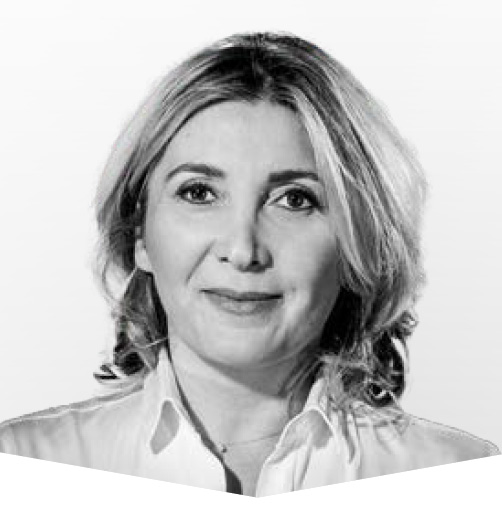
Doctor of anti-aging and aesthetic medicine. Graduate of the Rouen medical faculty. Has specialised in preventative and performance medicine since 1997. Permanent member of the French Society of Aesthetic Medicine.
Infos: docteurisabellemeurgey.com