Pr Marc-Olivier Gauci

There is a lot of talk about AI and robotics in the operating room. Yet, one innovation is advancing largely under the media radar: the surgical digital twin—used not to “do more”, but but to make better decisions before operating. In practical terms, these models now enable surgical teams to:
- patient’s actual anatomy,
- procedure,
- urgent situations. A key point—rarely discussed—is that all this preoperative planning is currently neither visible nor truly valued, even though it directly determines the quality and safety of the surgical procedure itself.
ANTI-AGE & LONGEVITY MAGAZINE: WHAT IS THE CORE OF YOUR WORK THAT LED YOU TO TAKE AN INTEREST IN DIGITAL MODELS?
PR MARC-OLIVIER GAUCI: I specialise in shoulder surgery (arthroscopy, prostheses, etc.) combined with trauma surgery. I also focus on image analysis in my role as director of an INSERM research laboratory—a unit founded ten years ago that works on creating digital twins for surgical use. I am currently the President of the French Society for Computer-Assisted Orthopaedic Surgery and the director of the MedInTech congress. The core of my innovation work focuses on the “digital twin”—a technology that enables us to improve our performance in the operating room. While people often picture surgeons spending their entire day in the OR, the reality is that we spend a great deal of time in consultations, preparing cases and making decisions regarding diagnoses and upcoming procedures. Digital twins allow us to better understand patient issues and potential complications, enhance the safety of the procedure, and improve information sharing between medical centres.
AA&LM: DO YOU APPLY DIGITAL TWIN TECHNOLOGY TO YOUR SPECIALITY?
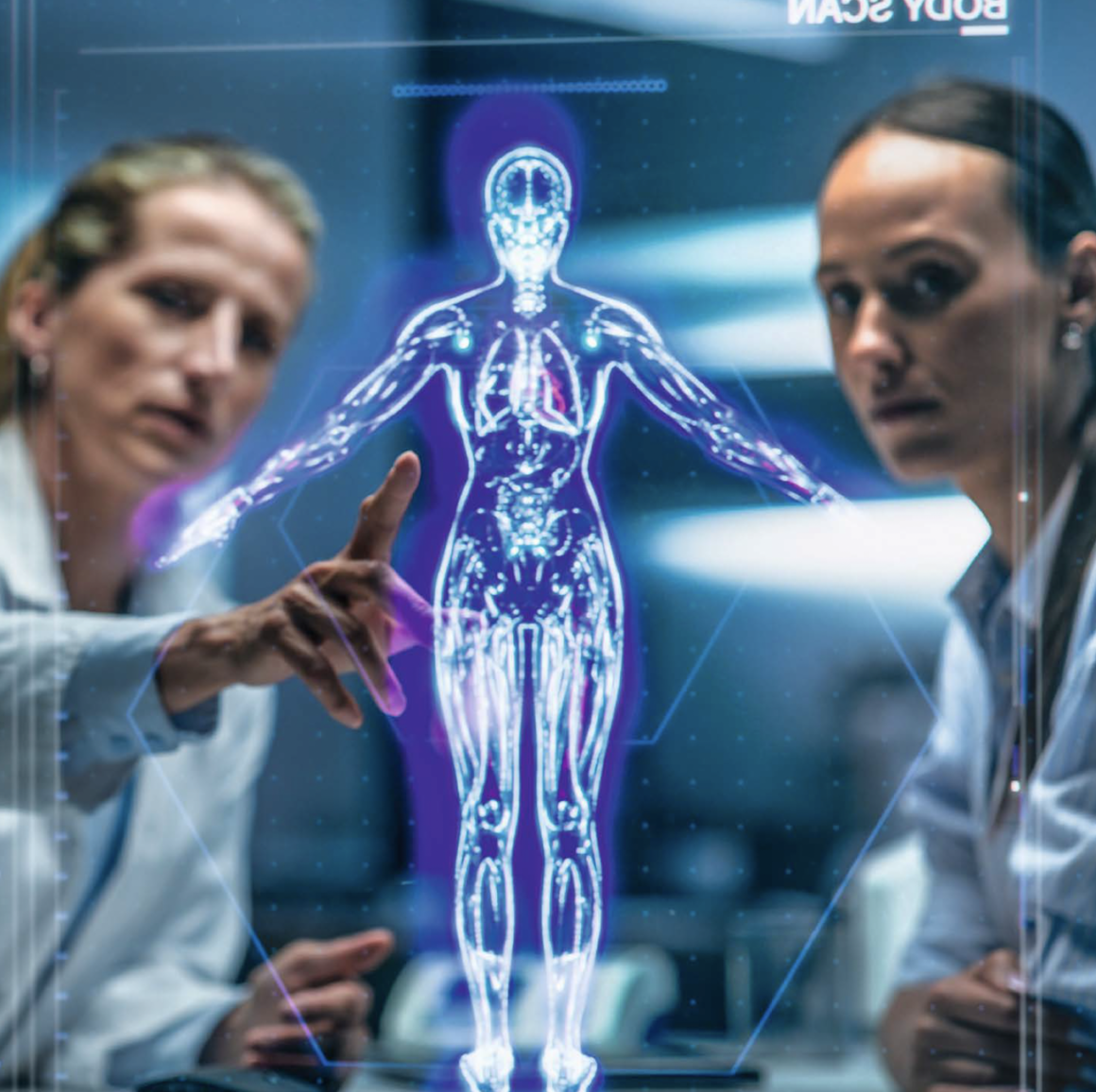
PR M.A.G.: In the context of shoulder replacement surgery, we replace the joint; to do this, we create a digital model that simulates the procedure. We map the patient’s characteristics—such as their skeleton and muscles—in 3D, and then test various surgical options to select the best solution. We also have access to 3D-printed instruments that guide our actions during the operation, as well as the ability to 3D-print the prostheses themselves. To create the model, we use a high-resolution 3D scanner; the software then extracts the pathological skeletal structure—identifying issues like osteoarthritis or fractures. AI-driven algorithms are essential for this type of data processing.
AA&LM: IS THERE A BUSINESS MODEL FOR THE USE OF DIGITAL TWINS?

PR M.A.G.: It is difficult to monetise the added value directly; while optimising procedures yields benefits, the economic impact is hard to quantify unless the technology is tied to a specific commercial implant. A manufacturer can offer the corresponding digital twin alongside its prosthesis. A universal, generic implant—accessible to everyone for every case—is not yet a reality, though work is underway to achieve it. However, the robot—an example of a digital twin application—is proving its worth in knee replacement surgery. It can assist in positioning cutting guides or perform the cutting procedure itself with greater precision than a human.
AA&LM: DO YOU RETAIN THE DIGITAL TWINS FOR POST-OPERATIVE FOLLOW-UP?
PR M.A.G.: Yes, certainly. They allow us to compare the outcome with the actual procedure and share knowledge with colleagues. They are also vital from a legal standpoint; should a problem arise, they may be requested during legal proceedings. With this planning and simulation process, our legal obligation is one of “means” rather than “results”. It is becoming almost a legal prerequisite.
AA&LM: IS THERE POTENTIAL FOR TRAINING PURPOSES?
PR M.A.G.: Yes. If we improve this technology, we will be able to train young surgeons more quickly. Current research focuses on AI-driven algorithms to optimise signal and image analysis—particularly for fractures, where automation remains difficult because fragments are hard to detect and attribute to specific bones. In other areas, such as liver or lung surgery, digital models are more advanced. Implanted prosthetics can also provide information, such as pH, to detect infection and alter the digital twin. These are called active implants.
AA&LM: DOES THE FUTURE LIE IN PREDICTIVE TECHNOLOGY?
PR. M.A.G.: Eventually, the digital twin could indicate the potential variations and evolution of an implant, and predict—or even prevent—the need for an intervention. By analysing the morphology of the acromion (shoulder bone) alongside hundreds of digital twins, we can identify the potential progression of a specific type of osteoarthritis—even in patients as young as 30. Preventive physical therapy or exercise sessions could halt this progression.
Pr Marc-Olivier Gauci
Prof. Marc-Olivier Gauci is an orthopedic surgeon at the Nice University Hospital (CHU de Nice). He heads the ICARE unit (Inserm U1091), the 3IA Côte d’Azur Institute Chair, the PACA Health Data Hub, and the ReBone FHU/RHU. He is also the president of the MedInTechs Society scientific congress.