Dr Nina Hassani
First clinical study using ultrasound assessment to demonstrate the efficacy of autologous EZGEL for tear trough rejuvenation and dermal regeneration.
The tear trough is one of the most challenging areas in aesthetic medicine because of its complex anatomy and delicate tissues. EZGEL, an innovative autologous biomaterial, combines a thermally denatured albumin matrix providing durable structural support with injectable PRF rich in growth factors, integrating volumetric correction with tissue regeneration The tear trough is one of the most challenging indications in aesthetic medicine. This region combines extremely thin skin, complex anatomy, superficial vascularisation, and limited tolerance to volumising agents.
Although hyaluronic acid fillers remain the gold standard for correction, they may be associated with persistent oedema, contour irregularities, the Tyndall effect and, more rarely, vascular complications. Moreover, they primarily restore lost volume without directly improving tissue quality, which plays a major role in periorbital aging. The emergence of regenerative medicine has progressively changed our therapeutic approach. The objective is no longer limited to replacing lost volume but also to stimulate the tissue’s natural regenerative capacity in order to achieve more harmonious, longer-lasting and physiological results.
Autologous biomaterials have therefore become an increasingly attractive option in facial rejuvenation. Injectable platelet-rich fibrin (i-PRF) is obtained from the patient’s own blood without the use of anticoagulants. Rich in platelets, leukocytes and growth factors, it promotes fibroblast proliferation, neocollagenesis, angiogenesis and extracellular matrix remodelling through the progressive release of bioactive mediators. However, despite its remarkable biological potential, i-PRF alone has limited mechanical stability and is rapidly resorbed, reducing its ability to provide adequate structural support in areas requiring volume restoration. EZGEL was developed to overcome these limitations by combining the biological activity of i-PRF with the structural properties of thermally denatured autologous albumin. The albumin forms a stable three-dimensional protein matrix that enhances viscosity, cohesion and tissue support, while i-PRF provides a sustained release of growth factors within the surrounding tissues. This unique combination creates an autologous biomaterial capable of providing immediate structural support while promoting progressive dermal regeneration. To evaluate this innovative approach, we conducted a prospective single-centre study at Cardiomed Jura involving eleven patients presenting moderate to severe infraorbital hollowing.
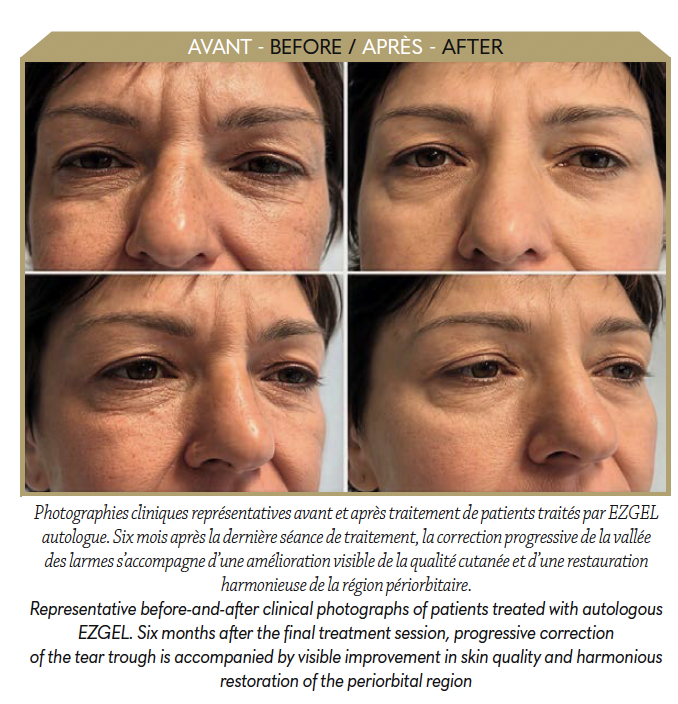
The treatment protocol consisted of three standardised EZGEL injection sessions performed at baseline, one month and three months using a 25G cannula. Injections were delivered primarily into the upper SOOF and the adjacent deep midface compartments, allowing homogeneous distribution of the biomaterial while respecting the delicate anatomy of the periorbital region. One of the major strengths of this study lies in its multimodal assessment. Clinical improvement was evaluated using two validated outcome measures: the Merz Infraorbital Hollow Assessment Scale (MIHAS) and the Global Aesthetic Improvement Scale (GAIS). In addition, high-frequency ultrasonography was used to objectively assess structural skin changes by measuring dermal thickness in the standardised infraorbital region. Examinations were performed before treatment and repeated at one, three and six months using identical anatomical landmarks and standardised imaging conditions. Clinical outcomes demonstrated progressive improvement throughout the six-month follow-up period.
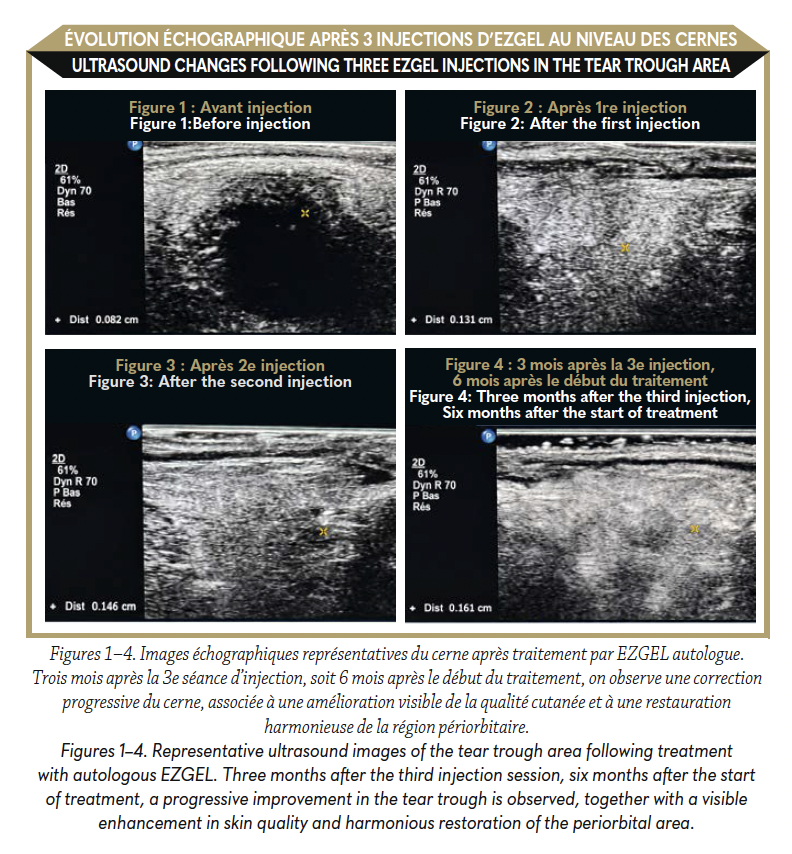
The mean MIHAS score decreased from 3.41 at baseline to 1.50 after six months, corresponding to an average improvement of nearly 56%. Every patient improved by at least one MIHAS grade, while more than half achieved an improvement of two grades or more. Standardised clinical photographs confirmed progressive restoration of the tear trough with a natural appearance while preserving facial harmony. Patient-reported outcomes were consistent with these clinical observations. At six months, most participants rated their aesthetic improvement as good or very good according to the GAIS score. The continued improvement observed between the third and sixth months suggests that treatment efficacy extends beyond immediate volumisation and reflects an ongoing biological remodelling process. High-frequency ultrasound provided additional objective evidence supporting this hypothesis. A progressive and homogeneous increase in dermal thickness was observed in every patient without exception. Mean dermal thickness increased by 0.054 mm on the right side and 0.062 mm on the left side after six months. These reproducible structural changes strongly support the concept that EZGEL induces genuine dermal remodeling rather than acting solely as a temporary volumising material. An exploratory analysis also suggested a greater dermal gain in younger patients, probably reflecting a higher intrinsic regenerative capacity. Nevertheless, clinically meaningful improvement was observed across all age groups, indicating that the aesthetic benefits of EZGEL result from multiple complementary mechanisms, including structural support, improvement in skin quality and progressive tissue regeneration.
Autologous EZGEL represents a promising advance in regenerative aesthetic medicine. By combining structural support with biological stimulation, it offers an innovative alternative to conventional fillers for tear trough rejuvenation, providing natural and long-lasting results.
Dr Nina Hassani

FMH member physician in Switzerland and Medical Director of Cardiomed Jura. Trained in aesthetic medicine and longevity at CIMEL Paris, she has practised autologous regenerative medicine since 2016, particularly PRP, PRF, i-PRF, and Alb-PRF/EZGEL. Author of scientific publications and international speaker. Co-founder and Secretary General of IMSARM.